
There are matches you watch for the result. Then there are matches that rearrange something inside of you.
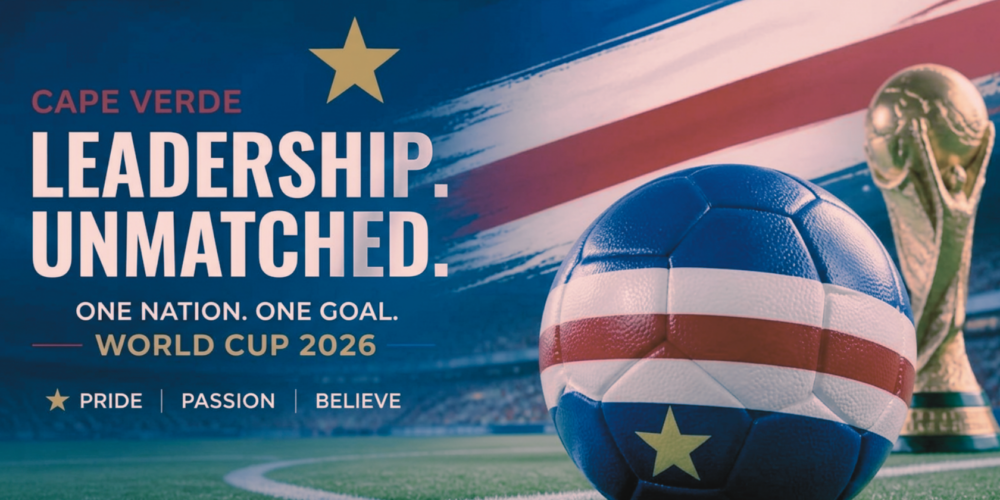
The July 3, 2026 Round of 32 clash between Argentina and Cape Verde at Hard Rock Stadium in Miami was the second kind. Argentina won 3-2 in extra time. But by the time the final whistle blew, the scoreboard had become the least interesting thing about what just happened.
This is not a football post. Well, it starts as one. But it becomes something else entirely.
Because what Vozinha and the Blue Sharks of Cape Verde did on that field gave every leader, entrepreneur, believer, and dreamer watching a masterclass that most business books charge $29.99 to teach.
Let us start at the beginning.
A Brief History of Cape Verde, The Nation Behind the Story
Before we talk about the lessons, we need to talk about the land.
Cape Verde, officially known as the Republic of Cabo Verde since a formal rebranding in 2013 when the government requested the international community adopt its Portuguese name, is an archipelago of ten volcanic islands located in the central Atlantic Ocean, approximately 570 kilometers off the coast of West Africa.
The islands were uninhabited when Portuguese explorers arrived in 1456. They became a significant hub in the transatlantic slave trade, a painful and defining chapter in the nation’s history that shaped its deeply mixed Creole culture, known as Kriolu, blending African, Portuguese, and Brazilian influences into a distinct identity found nowhere else in the world.
Cape Verde gained independence from Portugal on July 5, 1975, and has since become one of Africa’s most stable democracies and one of only a handful of African nations classified as middle-income by the World Bank.
The population is approximately 500,000 across its islands, making it one of the smallest nations on earth by population. To put that in perspective, Argentina’s population is approximately 46 million, roughly 92 times larger.
And yet.
Cape Verde at the 2026 FIFA World Cup: Just the Facts
Cape Verde, ranked No. 67 in the world by FIFA entering the tournament, made history at the 2026 FIFA World Cup as the smallest nation by land area ever to reach the knockout rounds. They advanced from their group after finishing second behind Spain with three draws and three points.
Their goalkeeper, Vozinha, whose full name is Josimar José Évora Dias, entered the tournament at 40 years old with 50,000 Instagram followers and a quiet reputation as a legend in Cape Verdean football who, as his own teammate put it, “probably hasn’t gotten the recognition he deserves.”
By the time Cape Verde faced Argentina, Vozinha had already made history. He had kept two clean sheets in the tournament, making him only the third goalkeeper in FIFA World Cup history to record multiple clean sheets after turning 40. His Instagram following had grown to 14 million before the Argentina match even kicked off.
Then Friday, July 3 happened.
Against the world’s No. 1-ranked team, the defending champions, and a certain Lionel Messi who entered the match with a record-extending 20 career World Cup goals, including six in this tournament alone, Vozinha made eight saves, four of them directly denying Messi. He sent the match to extra time with a stoppage-time stop that left the entire stadium silent. He did everything but win.
Argentina advanced 3-2. Cape Verde went home. And Vozinha left with 18.4 million Instagram followers and counting, and something far more valuable than a scoreline.
He left with a legacy.
Here are seven leadership lessons that this game continues to teach.
7 Leadership Lessons From Vozinha and Cape Verde
Lesson 1: Your Odds Are Not Your Destiny
Argentina entered this match ranked No. 1 in the world. Cape Verde was ranked No. 67. That is the widest ranking gap between any two opponents in the entire Round of 32. On paper, this match had no business being close.
It lasted over two and a half hours in real time and ended in extra time.
The odds did not write the story. The people on the field did.
Leadership application: How many times have you talked yourself out of the room before you even walked in? The gap between where you are and where you are going is real, but it is not final. Show up anyway. Every single time.
Lesson 2: One Committed Person Changes Everything
Cape Verde defender Pico Lopes said it plainly about Vozinha: “A worse goalkeeper for Cape Verde, and it’s a blowout.”
One person. In the right position. With full commitment. Changed the entire trajectory of a match, a tournament, and a nation’s history.
Leadership application: You do not need a full team of exceptional people to change an outcome. You need the right person, fully committed, in the right seat. Be that person for your team. And when you are building your team, look for that person relentlessly.
Lesson 3: Humility Is a Power Move
Before facing the greatest player alive, Vozinha posted a message to his supporters that closed with these words: “From Cape Verde to the world, with true humility and a heart full of gratitude.”
No chest-thumping. No braggadocio. Just gratitude. Just presence. Just a man fully aware of what the moment meant and choosing humility as his posture going into it.
Leadership application: The loudest person in the room is rarely the most powerful one. Humility and confidence are not opposites. They are partners. The leaders who last understand that distinction deeply.
Lesson 4: Age Is Not a Disqualifier
Vozinha is 40 years old. In professional football, that is practically ancient. Most goalkeepers retire in their mid-thirties. Vozinha showed up at the World Cup at 40 and became only the third goalkeeper in the tournament’s entire history to record multiple clean sheets after that age.
He did not apologize for his age. He used every year of it.
Leadership application: Stop letting the number define the narrative. Your experience, your resilience, your hard-won wisdom, those are not liabilities. They are your greatest competitive advantage. Vozinha just proved it on the biggest stage in the world.
Lesson 5: Authentic Influence Cannot Be Manufactured
Vozinha began this tournament with 50,000 Instagram followers. After Cape Verde’s opening draw against Spain, he had 8 million. By the morning after the Argentina match, he had 18.4 million.
He did not run a campaign. He did not hire a social media strategist. He did not optimize his content calendar. He just showed up, did his job with everything he had, and let the work speak.
Leadership application: This is the lesson Jade learns in my novella, Influence God’s Way With Us, that real influence is not built on strategy alone. It is built on integrity, consistency, and purpose. The platform followed the performance. It always does.
Lesson 6: Know Your Why Before the World Knows Your Name
Here is the detail that completely stopped me.
All that Vozinha wanted from this World Cup was for his mother to see him play.
Not the followers. Not the fame. Not the historic milestone. Just his mother, watching him do what he loves, on the biggest stage in the world.
He got that. And then the world gave him everything else.
Leadership application: When your purpose is rooted in something real and personal, bigger than the spotlight, the spotlight tends to find you anyway. Know your why before you chase the what. It will hold you when the pressure comes.
Lesson 7: The Scoreboard Does Not Tell the Whole Truth
Argentina advanced. Cape Verde went home. By the standard measurement, Cape Verde lost.
But Cape Verde coach Bubista said it best after the match: “We want to evolve so that we can have more opportunities to face the so-called big dogs of the tournament.”
There was no defeat in that dressing room. There was history. There was pride. There was a foundation being laid for every Cape Verdean footballer who came after this squad.
The scoreboard said 3-2. History said something else entirely.
Leadership application: Stop measuring your journey exclusively by outcomes. How you showed up, what you built, and who you became in the process matter just as much as the final number. Cape Verde did not win the match. They won something far more lasting.
The Closing Thought
Vozinha’s story and Jade’s story in Influence God’s Way With Us share one thread.
Both were under pressure. Both were being watched. Both had to decide what their influence really was for.
Jade did not set out to go viral. She set out to be true.
Vozinha did not set out to be famous. He just wanted his mother to see him play.
Real influence was never about the numbers. It was always about the purpose behind them.
If that resonates with you, Influence God’s Way With Us was written for exactly this moment in your life. Grab your book copy today.